Modular Wind Tunnel – Design, Measurement & Visualization (ENSAM)
Developed as part of an ENSAM engineering project, this work focuses on the design of a
modular wind tunnel intended for both aerodynamic experimentation and
STEM-oriented teaching. The objective was to create a platform that is
flexible, accurate, and accessible, while remaining compatible with in-house manufacturing constraints.
Starting from an existing open-source concept, the approach was to keep the best ideas and
redesign the full system to improve aerodynamic performance and measurement capability.
The final vision includes an automated workflow (data acquisition, polar plotting, and dashboard-based visualization).
Key Outcomes
- Modular architecture: Defined a complete modular layout (inlet, flow straightener, contraction, test section, diffuser) to adapt quickly to different teaching and research needs.
- Flow conditioning upgrade: Designed a new honeycomb/flow straightener concept (PLA → aluminum) for improved durability and reduced roughness, with geometry optimized for better laminarization.
- Contraction module: Implemented a contraction profile based on a 5th-degree polynomial, increasing the inlet/outlet area ratio to reduce turbulence and pressure losses.
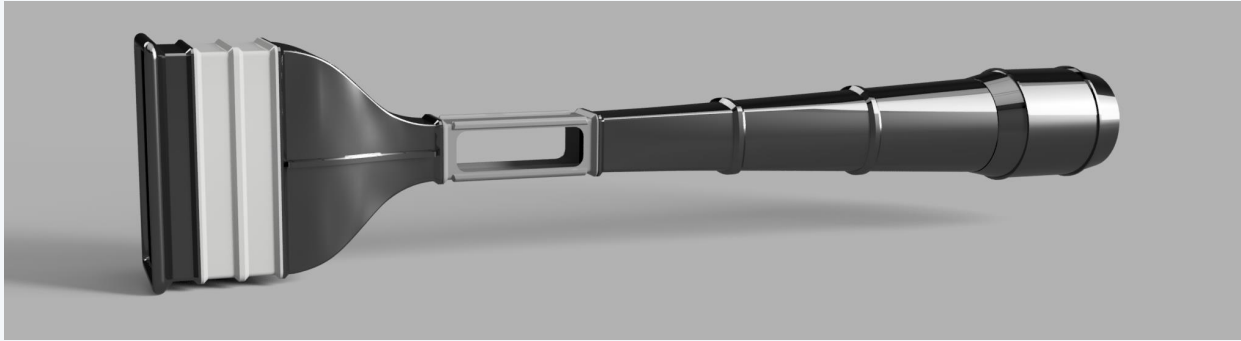
- Measurement tooling: Designed and 3D-printed a Pitot tube (resin) to measure airflow speed and support the computation of aerodynamic coefficients.
- Test section for F1 in Schools: Dimensioned the test section length around F1 in Schools constraints, with an instrumentation-friendly layout and interchangeable modules.
- Diffuser sizing: Designed a diffuser with an opening angle limited to ~3° (per literature) to minimize boundary-layer separation risk and keep the flow stable.
- Aero coefficients: Established the measurement chain to compute drag (Cx) and lift (Cz) from force and velocity measurements.
- Automation: Built an Arduino-based incidence sweep (servo-controlled) enabling automatic angle variation (e.g., 0°→60° with step increments) and continuous data acquisition.
This project resulted in a robust foundation for a modular aerodynamic platform, combining
mechanical design, aerodynamic optimization, and instrumentation.
Next steps include enhanced visualization modules (smoke/laser/LED), a web interface for real-time plotting,
and simplified force-measurement solutions (e.g., a lighter calibration approach than a full 6-DOF balance).
View Full Report (PDF)