Industrial Gear Reducer – Preliminary Design (E12)
Preliminary design study carried out at Arts et Métiers (ENSAM),
focused on the early-stage conception of a parallel-axis industrial gearbox
designed to transmit 7 kW with a reduction ratio of 4:1.
with an input speed of 1500 rpm.
The goal was to evaluate technical feasibility, define the general architecture,
and perform the preliminary sizing of the main mechanical components.
The study covered functional definition,
benchmarking of existing solutions,
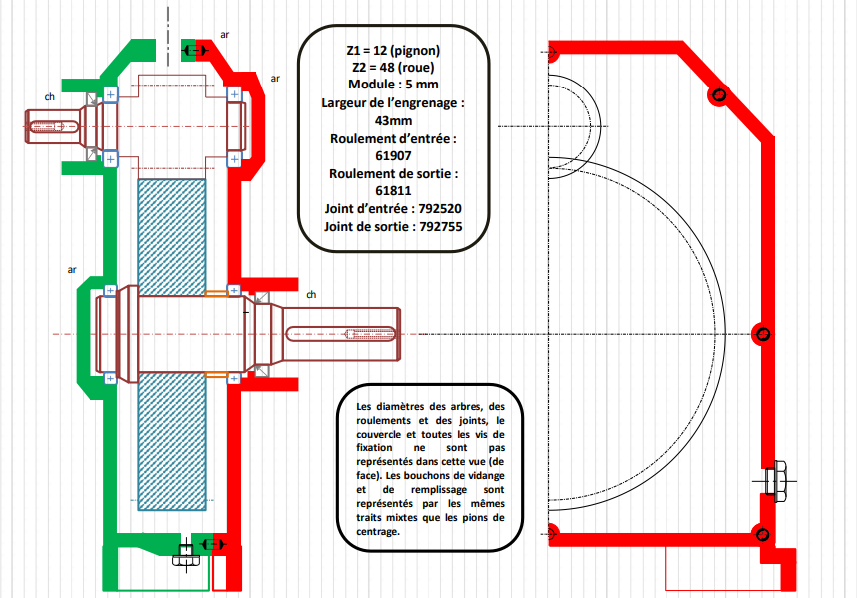
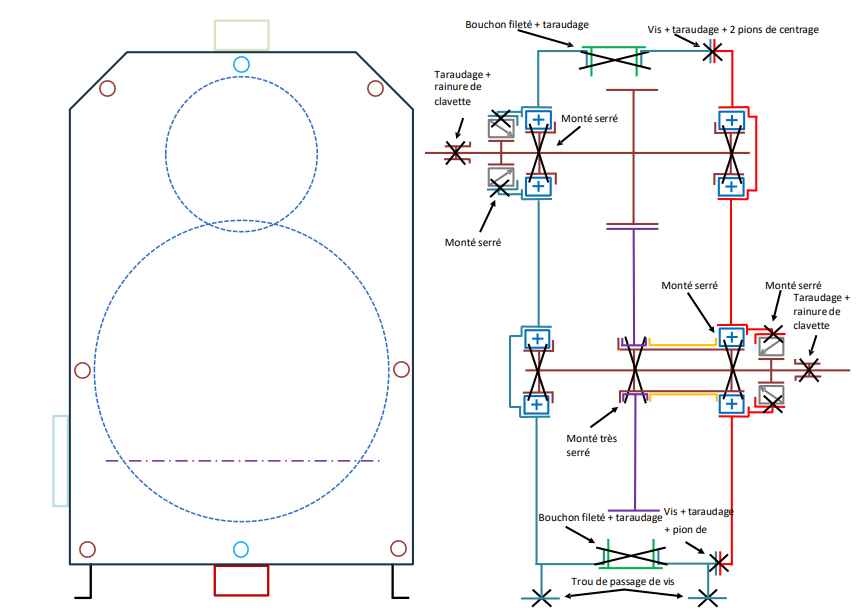
analysis of the mechanical architecture ("en chape" configuration to limit shaft deflection),
as well as the preliminary sizing of the gear set, shafts, keys, bearings,
and seals. Lubricant selection and thermal evaluation were also carried out.
Main Specifications
- Power / Ratio / Speed: 7 kW – i = 4 – N = 1500 rpm
- Target lifetime: 22,000 h (functional)
- Architecture: Parallel shafts, "en chape" mounting (non-cantilevered)
Selected Technical Solutions
- Transmission: Spur gear set, 12/48 teeth
- Module / Face width: m = 5 mm; width ≈ 43 mm
- Materials: 35CrMo4 for gears, 34CrMo4 for shafts
- Bearings: SKF 61907 (input) and SKF 61811 (output)
- Seals: Lip seals (Paulstra)
- Housing: Two-part cast iron casing, offset joint plane, integrated oil level window
Preliminary Sizing
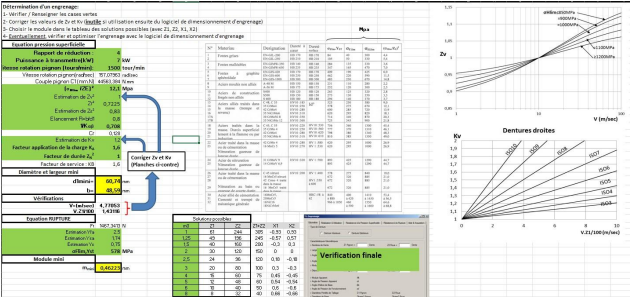
- Gear set: m = 5 mm; Z1=12, Z2=48; validated through spreadsheet and Engrenage.exe tool
- Shafts: Ø ≈ 19–21 mm (input) and ≈ 31 mm (output) – verified using Tresca and stiffness criteria
- Keys: length ≈ 35 mm (input) and ≈ 80 mm (output)
Lubrication
Oil bath lubrication verified using the Shell method (speed limits met).
The viscosity determined by the speed-based approach resulted in an oil temperature
of approximately 95 °C.
The selected oil is MACOMA R71, suitable for enclosed gear systems.
This preliminary study confirmed the system's technical feasibility
and identified trade-offs between cost, durability, and compactness.
The next steps will focus on full 3D modeling,
tolerance calculations, and detailed thermal analysis.
View Report PDF